9 Surprising Benefits of Rock Sugar for Cough Relief You Didn’t Know
Table of Contents
- Introduction
- Key Takeaways
- Ayurvedic Benefits of Rock Sugar for Respiratory Health
- Mishri vs. Regular Rock Sugar
- How Rock Sugar Helps with Cough
- Using Rock Sugar for Sore Throat
- Rock Sugar for Children
- Rock Sugar for Diabetics
- Side Effects of Using Rock Sugar for Cough
- Disclaimer
- FAQs
Key Takeaways
Can rock sugar help a cough?
Yes, it can provide temporary relief for mild coughs by soothing the throat, coating irritated mucous membranes, and slightly suppressing the cough reflex. Its benefit is mostly symptomatic, not curative.
Can rock sugar be used for a sore throat?
Absolutely. Rock sugar forms a gentle syrup when dissolved, coating the throat to reduce dryness and irritation. It can be combined with warm water, lemon, or herbal teas for added comfort.
Does rock sugar help with mucus?
Rock sugar may help loosen and thin mucus when used with herbs like ginger or black pepper. However, excessive intake can increase mucus production due to its sugar content.
Is rock sugar better for dry cough or chesty cough?
Rock sugar is most effective for dry coughs by soothing throat irritation. For chesty coughs with mucus, it may offer mild relief when combined with expectorant herbs but isn’t a substitute for proper mucus-clearing remedies.
Can children use rock sugar for cough?
Yes, toddlers over one year old can use small, dissolved amounts to soothe mild coughs. Avoid giving whole crystals to prevent choking, and never give to babies under one year.
Can diabetics use rock sugar for cough relief?
No. Rock sugar can raise blood glucose levels like regular sugar. Diabetics should use sugar-free alternatives or herbal remedies instead.
What are the side effects of using rock sugar for cough?
Overuse can cause blood sugar spikes, weight gain, tooth decay, digestive discomfort, or rare allergic reactions. Use in moderation (5–10 grams/day) and as a temporary remedy, not a long-term solution.
Is rock sugar a substitute for medical treatment?
No. Rock sugar provides temporary symptomatic relief but does not treat the underlying cause of a cough. Consult a healthcare professional if symptoms are severe or persistent.


An advisor to the American Anti-Cancer Institute and 3-Time Canadian Natural Bodybuilding Champion, Mr. Wade Lightheart, is one of the world’s premier authorities on Natural Nutrition and Training Methods.
He says “Most healthy individuals typically only get 1-2 forms of magnesium at best (much of the population is deficient in all forms)
– but when you get all 7 major forms of magnesium, you can truly experience the benefits.”
What are the Ayurvedic benefits of rock sugar for respiratory issues?
In Ayurveda, rock sugar, also known as Mishri or Khadi Shakkar, is valued not just as a natural sweetener but also as a gentle remedy for various respiratory ailments. Its cooling, soothing, and lubricating qualities make it a common ingredient in many traditional Ayurvedic formulations that support healthy lungs and airways.
1. Soothes the Throat and Eases Irritation
Mishri helps calm sore or dry throats by coating and moisturizing the mucous membranes. Its cooling effect reduces irritation and burning sensations often caused by persistent coughing or throat infections.
2. Acts as a Natural Expectorant
Known for its Kapha-balancing properties, rock sugar assists in loosening and expelling mucus from the respiratory tract. This makes breathing easier and provides relief from congestion in cases of productive (wet) cough.
3. Balances Vata and Pitta Doshas
With its sweet taste and cooling nature, Mishri helps balance Vata (linked to dryness and dry cough) and Pitta (associated with heat and inflammation). This dual action supports overall harmony in the respiratory system.
4. Supports Relief from Cough and Cold
Rock sugar is a key component in classical Ayurvedic formulations like Sitopaladi Churna and Talisadi Churna. These blends are known to soothe coughs, clear phlegm, and calm irritation in the throat and chest.
5. Boosts Energy and Recovery
During respiratory infections, the body often feels weak or fatigued. Mishri provides a quick source of natural energy, helping restore vitality and strength while the body recovers.
6. Enhances the Effects of Herbal Remedies
When combined with warming herbs like ginger, tulsi (holy basil), or black pepper, rock sugar enhances their cough-suppressing and immune-boosting benefits. The blend of sweet and spicy elements works synergistically to promote clearer breathing and stronger immunity.
7. Cooling and Calming Effect on the Body
Because of its naturally cooling nature, rock sugar helps regulate internal heat. This is especially useful in soothing respiratory discomfort caused by inflammation or excessive heat in the body.

What Is the Difference Between Mishri and Regular Rock Sugar?
Although Mishri and rock sugar may look similar, they are quite different in how they’re made, their purity, and their effects on health. In Ayurveda and traditional Indian households, Mishri holds a special place not only as a sweetener but also as a mild therapeutic ingredient.
1. Processing and Purity
Mishri is an unrefined, crystallized form of sugar made by slowly evaporating sugarcane juice or palm sap without the use of chemicals. The syrup is allowed to crystallize naturally on cotton threads — a process that can take several days. Because of this slow, natural crystallization, Mishri retains small amounts of minerals and has a gentle, natural sweetness with a faint molasses flavor.
Regular rock sugar, often called rock candy, is made from refined white sugar. The sugar syrup used is purified, sometimes colored or flavored, and rapidly crystallized. This process removes all trace minerals, leaving behind only pure sucrose crystals.
2. Composition and Mineral Content
Mishri is less processed and therefore retains trace minerals from the original sugarcane juice. These minerals contribute to its slightly complex flavor and mild alkalinity.
Regular rock sugar, on the other hand, is chemically pure sucrose — uniform, clear, and free from any minerals or natural compounds. It’s essentially decorative or used purely for sweetness.
3. Ayurvedic and Health Perspective
In Ayurveda, Mishri is valued for its cooling, soothing, and balancing properties. It helps balance Vata and Pitta doshas, aids digestion, and is often used in herbal remedies for cough, sore throat, and fatigue.
Regular rock sugar doesn’t hold these benefits. Since it is fully refined, it is seen merely as a sweetener without any therapeutic or energetic value.
4. Visual and Authentic Markers
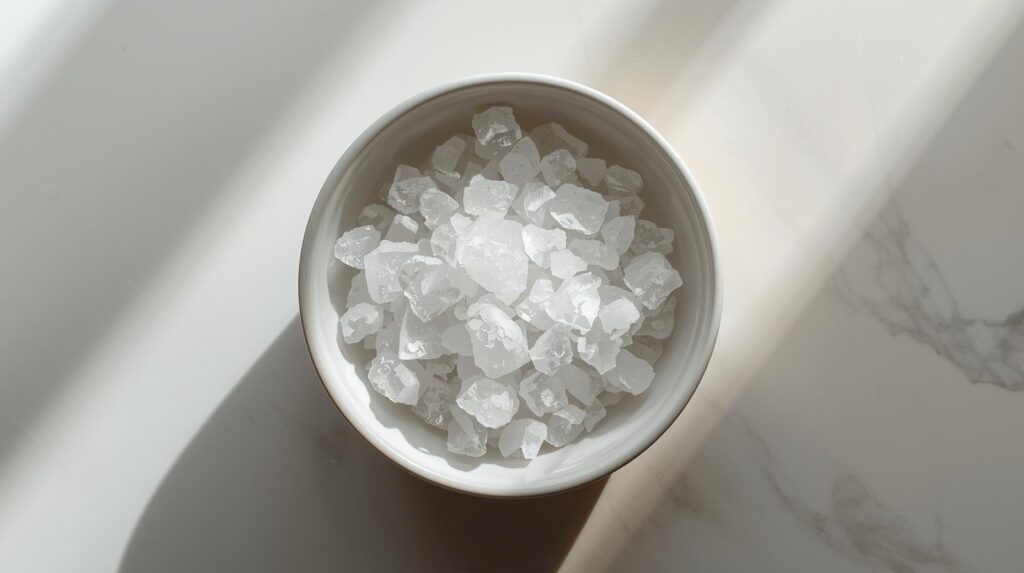
Authentic Mishri, known as Dhage Wali Mishri, can be identified by its thread running through the crystals. The crystals are often irregular in shape and slightly off-white in color.
Regular rock sugar, however, forms clear, uniform crystals. It is often sold on sticks or as large transparent chunks and contains no thread.
5. Taste and Uses
Mishri has a gentle, cooling sweetness that doesn’t overpower other flavors. It is commonly used in Ayurvedic medicines, mouth fresheners, and natural sweet blends.
Regular rock sugar is used more for culinary decoration, desserts, or sweetening beverages where taste complexity or mineral content isn’t a concern.
In Summary
The main difference lies in how they are made and what they offer.
- Mishri is a traditional, unrefined crystal sugar that retains minerals, carries Ayurvedic benefits, and is cooling to the body.
- Regular rock sugar (or rock candy) is a refined, decorative sweetener with no medicinal properties.
If you’re looking for something that nourishes and balances in addition to sweetening, Mishri is the superior choice.
This Critical Mineral Holds The Key
To A Perfect Night’s Sleep – No Matter What Your Age.
Mishri vs. Regular Rock Sugar: Key Differences
Feature | Mishri (Dhaga Mishri / Khadi Shakkar) | Regular Rock Sugar (Rock Candy) |
Processing Method | Made by slowly crystallizing raw sugarcane juice or palm sap on cotton threads without chemicals. Traditional, natural, and unrefined process. | Made by rapidly crystallizing refined white sugar syrup, often with additives or coloring. Highly processed. |
Base Ingredient | Raw or minimally processed sugarcane juice. | Refined white sugar (sucrose). |
Crystallization | Forms naturally on threads (Dhage Wali Mishri) through slow evaporation. | Crystallized from refined syrup, usually without threads. |
Mineral Content | Retains trace minerals and nutrients from sugarcane juice. | Contains no minerals — 100% pure sucrose. |
Taste and Texture | Mildly sweet with a hint of molasses flavor; irregular crystal shapes. | Very sweet, neutral taste; uniform, clear crystals. |
Ayurvedic View | Considered medicinal — balances Vata and Pitta doshas, cooling, soothing, and light on digestion. | Viewed as a regular sweetener with no Ayurvedic or health benefits. |
Alkalinity | Slightly alkaline and cooling in nature. | Neutral to slightly acidic. |
Health Benefits | Soothes throat, aids digestion, supports respiratory and cooling therapies. | Primarily used for sweetening or decoration; lacks therapeutic value. |
Authenticity Marker | Identified by a thread running through it (Dhaga Mishri). | Clear, lump-like crystals without a thread. |
Common Uses | Ayurveda formulations, herbal blends, mouth fresheners, traditional desserts. | Confectionery, decorative sweets, and general sweetening purposes. |
Does Rock Sugar Actually Help a Cough, or Is It Just a Traditional Sweetener?
1. The Ayurvedic View: Soothing and Balancing
In Ayurveda, Mishri is valued for its cooling and soothing properties. It is often used in home remedies for cough, cold, and sore throat — especially when combined with ingredients like ginger, tulsi (holy basil), black pepper, or pear.
- Cooling effect: Rock sugar helps calm throat inflammation and irritation caused by persistent coughing.
- Mucus relief: When mixed with warming herbs such as black pepper or ginger, it supports the natural process of loosening and clearing mucus from the respiratory tract.
- Throat comfort: Slowly dissolving a piece of Mishri in the mouth helps moisturize dry mucous membranes, easing the tickle that triggers coughing.
So in Ayurveda, rock sugar is considered a gentle supportive remedy, not a cure. It is ideal for balancing Vata (dryness) and Pitta (heat and irritation) imbalances.
2. The Scientific Explanation: A Simple Soothing Mechanism
From a modern medical point of view, rock sugar’s benefits are primarily physical, not medicinal. Its relief comes from how it feels and tastes, rather than from any unique compounds it contains.
- Demulcent action: When rock sugar dissolves slowly, it forms a thin, sticky coating over the throat. This coating helps lubricate irritated tissue and calms the nerve endings responsible for triggering the cough reflex.
- Sweet taste effect: Studies show that the sweet taste itself can help suppress coughing. The sweetness activates taste receptors that send calming signals to the brain, reducing the urge to cough — a mild, natural anti-tussive effect.
- Comparable remedies: This is the same reason why honey, herbal lozenges, or simple sugar syrups can feel so effective. They soothe, coat, and comfort, even though they don’t address the underlying cause.
3. How Much Does It Really Help?
Rock sugar offers temporary relief from a mild, irritation-based cough. It’s excellent for those occasional dry or tickly coughs that don’t stem from infection. However, its effect is short-term . It doesn’t treat the actual source of inflammation or infection.
For persistent, severe, or recurring coughs, it’s important to consult a doctor to rule out underlying issues.
4. Bottom Line
- Yes, rock sugar can soothe a mild cough by coating the throat and calming irritation.
- No, it doesn’t cure coughs or respiratory infections.
- Think of it as a comforting traditional remedy — helpful for quick relief, especially when used with herbs like ginger or tulsi, but not a substitute for medical care.
Can I Use Rock Sugar for a Sore Throat?
Rock sugar (Mishri) is a traditional and gentle remedy often used to soothe a sore or dry throat. While it doesn’t treat the root cause of a sore throat, it provides quick, comforting relief from irritation, dryness, and that scratchy feeling that makes swallowing uncomfortable.
1. How Rock Sugar Helps a Sore Throat
The way rock sugar works is simple but effective — it’s all about its demulcent (throat-coating) action and its mild sweetness.
- Coating the throat: When you slowly dissolve a piece of rock sugar in your mouth, it turns into a light syrup that coats the mucous membranes of the throat. This thin, protective layer helps reduce friction, dryness, and pain caused by irritation.
- Cooling effect: Mishri is naturally cooling in nature, which makes it ideal for calming the heat and inflammation that often accompany a sore throat.
- Stimulates saliva: Sucking on rock sugar also encourages saliva production, keeping the throat moist, which is a key factor in easing soreness and preventing further irritation.
In essence, rock sugar works much like a natural throat lozenge — soothing, moistening, and cooling the irritated tissues.
2. Traditional Remedies with Rock Sugar
In Ayurvedic and folk medicine, rock sugar is often combined with other ingredients to enhance its effect:
- Rock sugar + black pepper: Helps clear mild congestion while soothing the throat.
- Rock sugar + ghee (clarified butter): Provides a lubricating and cooling effect, easing dryness and irritation.
- Rock sugar + warm water or lemon: Acts as a gentle throat rinse or drink for mild soreness.
These combinations are supportive home remedies that provide comfort, especially for irritation caused by talking too much, mild infections, or weather changes.
3. Important Note
Rock sugar offers temporary relief, not a cure. It can ease symptoms and make you more comfortable, but it won’t eliminate bacterial or viral infections.
If your sore throat persists for more than a few days, is severe, or comes with fever or swollen glands, it’s best to seek medical advice.
Related Posts You May Like
15 Magnesium-Rich Herbs and Spices: Are You Getting Enough?
10 Amazing Rock Sugar Benefits: Soothing, Digestive & Energy-Boosting Uses You Need to Know
7 Surprising Benefits of Mishri Rock Sugar You Need to Know
Discover Dhaga Mishri: India’s Pure, Unrefined Rock Sugar, Ingredients & 9 Ayurvedic Health Benefits
Can Rock Sugar Help With Mucus?
Rock sugar (Mishri) can help manage mucus, but its effect depends on how and how much you use it. In both Ayurvedic and Traditional Chinese Medicine (TCM), rock sugar has long been used in natural remedies to loosen phlegm, calm throat irritation, and ease breathing. However, moderation is key, since excessive sugar can have the opposite effect.
1. How Rock Sugar Helps With Mucus
Rock sugar’s benefit comes from its soothing and lubricating nature rather than from any strong medicinal compound.
- Loosens phlegm: When combined with herbs like black pepper, ginger, tulsi, or pear, rock sugar helps break down thick mucus, making it easier to cough up and clear from the respiratory tract.
- Soothes irritation: The slow-dissolving crystals coat and calm the throat, reducing inflammation caused by persistent coughing or post-nasal drip.
- Hydrates the airways: Dissolving rock sugar in warm liquids (like herbal teas or warm water) helps keep the throat and airways moist, which naturally thins mucus and makes it less sticky.
In TCM, a well-known example is Steamed Pear with Rock Sugar, a classic home remedy believed to nourish the lungs, ease coughing, and clear phlegm gently.
2. The Ayurvedic View
In Ayurveda, rock sugar is considered to have mild expectorant and cooling qualities. It helps balance Kapha dosha when used sparingly, which in turn reduces excessive mucus buildup.
However, when consumed in excess, sugar in any form can aggravate Kapha — leading to heaviness, congestion, and increased mucus formation.
So, Ayurveda supports its use for mucus relief, but only in small amounts and alongside balancing herbs like ginger or black pepper.
3. The Scientific Reality
From a modern health perspective, the soothing effect of rock sugar is largely mechanical and sensory:
- Its syrupy coating action helps calm throat irritation and temporarily ease coughing.
- The sweet taste can help suppress the cough reflex for short-term comfort.
But nutritionally, rock sugar is still sugar — and too much sugar can promote inflammation, which may increase mucus production in some individuals.
4. How to Use Rock Sugar for Mucus Relief
You can try these traditional, gentle methods:
- Warm water with rock sugar and black pepper: Helps clear mucus and soothe the throat.
- Rock sugar with ginger juice: A time-tested Ayurvedic mix to reduce congestion.
- Steamed pear with rock sugar: A Chinese home remedy for wet coughs and lung comfort.
Does Rock Sugar Work for Chesty Cough or Just Dry Cough?
Rock sugar, also known as mishri, is used in many traditional remedies for both dry and chesty coughs, but its role differs depending on the type of cough.
For Dry Cough:
Rock sugar is most effective for dry, irritating coughs that don’t produce mucus. When you suck on a piece, it slowly dissolves and coats your throat, forming a soothing layer that calms the cough reflex. It also stimulates saliva production, keeping your throat moist and easing dryness. Think of it as a natural lozenge. It doesn’t treat the root cause, but it makes the discomfort much more bearable.
For Chesty (Wet/Productive) Cough:
In traditional medicine systems like Ayurveda and Traditional Chinese Medicine (TCM), rock sugar is sometimes used in remedies for chesty coughs — especially when paired with other ingredients such as ginger, black pepper, or pear. These combinations are believed to help loosen thick mucus, making it easier to expel.
For example, the popular TCM recipe “Steamed Pear with Rock Sugar” is traditionally used to clear phlegm, nourish the lungs, and soothe the respiratory tract.
However, on its own, rock sugar isn’t an expectorant (a substance that clears mucus). It mainly soothes irritation rather than breaking down phlegm. In fact, too much sugar may sometimes increase mucus production or inflammation in sensitive individuals.
In short:
- For dry coughs → rock sugar works well to soothe and moisten the throat.
- For chesty coughs → it can offer mild relief when combined with other natural expectorants but shouldn’t be relied on as the main remedy.
Is Rock Sugar Safe for Children with Cough?
General Safety
Rock sugar is generally safe for children over one year old when given in small amounts and under adult supervision. It helps coat the throat, relieve irritation, and promote saliva flow, much like a mild natural lozenge.However, it’s important to remember that rock sugar doesn’t treat the root cause of a cough — it only provides temporary comfort.Key Safety Guidelines
- Avoid for Infants Under 1 Year
- Do not give rock sugar (or honey) to infants under 12 months. Babies have immature digestive systems and are more sensitive to natural sugars or impurities that could cause illness.
- Beware of Choking Hazards
- Rock sugar crystals are hard and can pose a choking risk, especially for children under 4 years old.
- Instead of giving solid pieces, dissolve it fully in warm water, herbal tea, milk, or mix it into porridge.
- Use in Moderation
- Rock sugar is still sugar, even if it’s less refined. Too much can increase mucus production, lead to tooth decay, and add unnecessary calories.
- Use it sparingly — just enough to coat the throat or sweeten a natural remedy.
- When to Seek Medical Help
- If the cough lasts more than a week, worsens, or comes with fever, difficulty breathing, or wheezing, consult a doctor immediately.
- Rock sugar can ease discomfort but should not replace medical care when symptoms persist.
Can I Give Rock Sugar to My Toddler for Cough?
Yes, you can give rock sugar (mishri) to your toddler for mild cough relief — but only if your child is over one year old and it’s given in a safe, dissolved form. Rock sugar can help soothe the throat, ease irritation, and slightly loosen mucus when mixed with warm liquids. However, it should always be used with care and moderation.
Age and Safety Guidelines
Guideline | Recommendation |
Age Limit | Safe for toddlers over 1 year old. Do not give to babies under 1 year due to possible contamination risk (similar to honey and botulism concerns). |
Form | Never give whole crystals. Always crush or dissolve rock sugar in warm water, milk, or herbal tea to prevent choking. |
Amount | Use very small amounts — just enough to lightly sweeten or soothe. Rock sugar is still sugar and should be used sparingly. |
Choking Risk | Hard crystals are dangerous for toddlers under 4 years old. Ensure the mixture is smooth or fully dissolved. |
Consultation | Always consult a pediatrician if your child’s cough is persistent, severe, or accompanied by fever or breathing issues. |
Easy, step-by-step instructions for creating your own spice blends from home.More than 200 spices from around the world

Where Can I Buy Rock Sugar?
You can buy high quality Rock Sugar Mishri from Amazon. There are many trusted sellers.
Can Diabetics Use Rock Sugar for Cough Relief?
Why Rock Sugar Is Not Safe for Diabetics
- Raises blood sugar: Rock sugar is concentrated sugar; even small amounts can significantly impact glucose levels.
- No glycemic advantage: Its traditional or Ayurvedic use does not reduce its carbohydrate effect.
- Calorie-dense: Higher sugar concentration means more calories per serving than regular sugar.
What are the side effects of using rock sugar for cough?
Rock sugar (mishri) is generally considered safe when used in small amounts, but excessive or frequent use can lead to side effects — mostly due to its high sugar content rather than any toxic effects.
1. Blood Sugar Spikes
- Rock sugar is primarily sucrose and has a high glycemic index, which can rapidly raise blood glucose levels.
- People with diabetes or insulin resistance should avoid it entirely.
2. Weight Gain and Obesity
- Regular consumption of rock sugar adds extra calories and may contribute to weight gain, increasing the risk of type 2 diabetes, high blood pressure, and heart disease.
3. Dental Issues
- Sugary foods feed oral bacteria, forming plaque that erodes enamel, leading to tooth decay and cavities.
4. Digestive Discomfort
- Overconsumption can cause bloating or upset stomach and may worsen symptoms of cough or cold rather than provide relief.
5. Allergic Reactions
- Rare, but possible in sensitive individuals.
6. Masking Underlying Conditions
- Using rock sugar to relieve symptoms may temporarily soothe a cough, but it can delay proper medical evaluation if the underlying cause is serious.
Disclaimer: The information provided here is based on traditional home remedies and general wellness practices. It is not a substitute for professional medical advice, diagnosis, or treatment. If your cough is severe, persistent, or accompanied by fever, difficulty breathing, or other serious symptoms, please consult a qualified healthcare professional immediately.

FAQs
Are there any side effects of using rock sugar for cough?
Yes, overconsumption can lead to blood sugar spikes, weight gain, tooth decay, digestive discomfort, and, rarely, allergic reactions. Use in moderation and as a temporary remedy.
Does rock sugar help with a dry cough or a wet (chesty) cough?
Rock sugar is most effective for dry coughs, as it soothes throat irritation and coats the mucous membranes. For chesty coughs, it may provide mild relief when combined with herbs like ginger or black pepper, but it is not an expectorant on its own.
Does rock sugar reduce mucus or irritation?
Rock sugar can temporarily soothe throat irritation and may help loosen mucus when paired with herbal remedies. However, excessive intake may increase mucus production due to its sugar content.
What is mishri, and can it cure my cough?
Mishri is traditional, unrefined rock sugar commonly used in Ayurveda. It soothes symptoms of cough but does not cure the underlying cause. Its benefit is temporary relief.
Can rock sugar cure a cough?
No. Rock sugar provides symptomatic relief by coating the throat and calming irritation, but it is not a cure for coughs. Persistent or severe coughs should be evaluated by a healthcare professional.
Is rock sugar really good for treating cough naturally?
Rock sugar is valued in traditional remedies for its soothing and throat-coating properties. It can be effective for temporary relief, especially when combined with warm liquids or herbs, but it should not replace medical treatment.
Is the rock sugar cough remedy safe for children?
It is generally safe for toddlers over one year old in small, dissolved amounts. Never give whole crystals to young children due to choking risk, and avoid use in babies under one year.
Can rock sugar cause side effects?
Yes, excessive consumption may cause blood sugar spikes, tooth decay, weight gain, digestive discomfort, or rare allergic reactions. Moderation is essential.
Can diabetics use rock sugar for cough treatment?
No. Rock sugar is high in sucrose and can raise blood glucose levels. Diabetics should use doctor-approved alternatives like sugar-free lozenges or herbal remedies.